
How it plays
Real netball, under your thumbs
Fast Seven plays the real game: seven positions with their legal zones, three seconds to pass, no running with the ball, and 0.9 metres between defender and ball. You don't need to know any of it. The whole court is on screen, one cue at a time shows your next move, and the game teaches each rule at the moment it matters.
A stick, two buttons and a tap
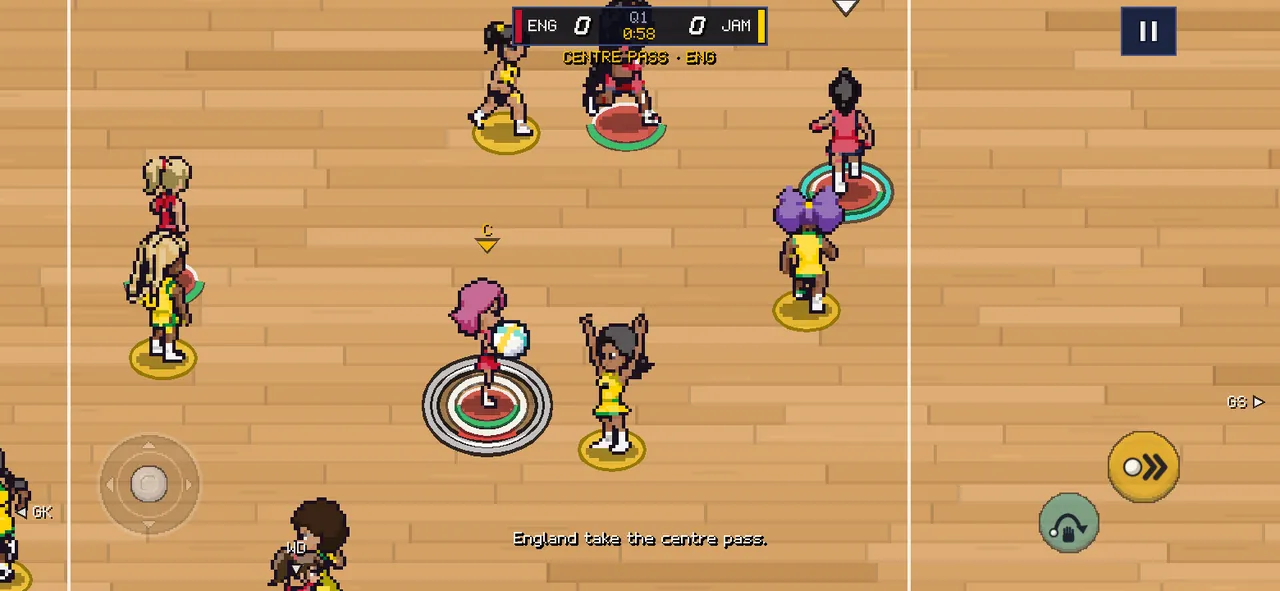
The stick on the left moves your player and aims, and she never takes a step she shouldn't: no footwork calls for you. The two buttons on the right change with the moment. To pass, you can also just tap a teammate.
 PassTo the aimed teammate, whose position shows over the button. Or tap the teammate herself.
 LobFloat it over a defender who's in the lane.
 ShootIn the circle, Pass becomes Shoot, and it glows when your shooter has a fair shot. Hold and release in the green.
 SwitchOn defence, take the player nearest the ball.
 DefendJUMP at a pass as the ring closes, or BLOCK at the ball.
Your player wears the cyan marker, and the hoop you attack glows all match. While you hold the ball, play slows down to give you time to think: half speed on Rookie and Club, three-quarter speed on Elite, full speed on World Class.
Four camera views
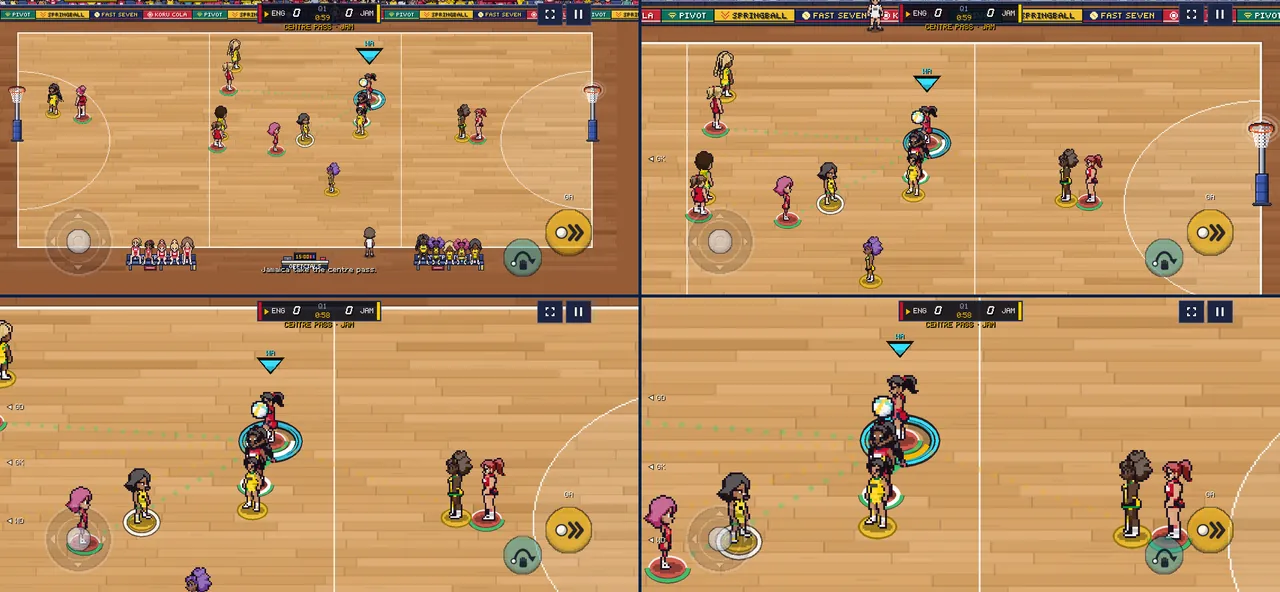
Matches start on WHOLE COURT: the court from post to post and all fourteen players, held still. On the smallest phones it follows the ball sideways instead.
The camera button beside pause steps through WHOLE COURT, WIDE, NORMAL and CLOSE during a match, and the game keeps the one you like. On a keyboard it's C, on a controller Y.
Pass lines
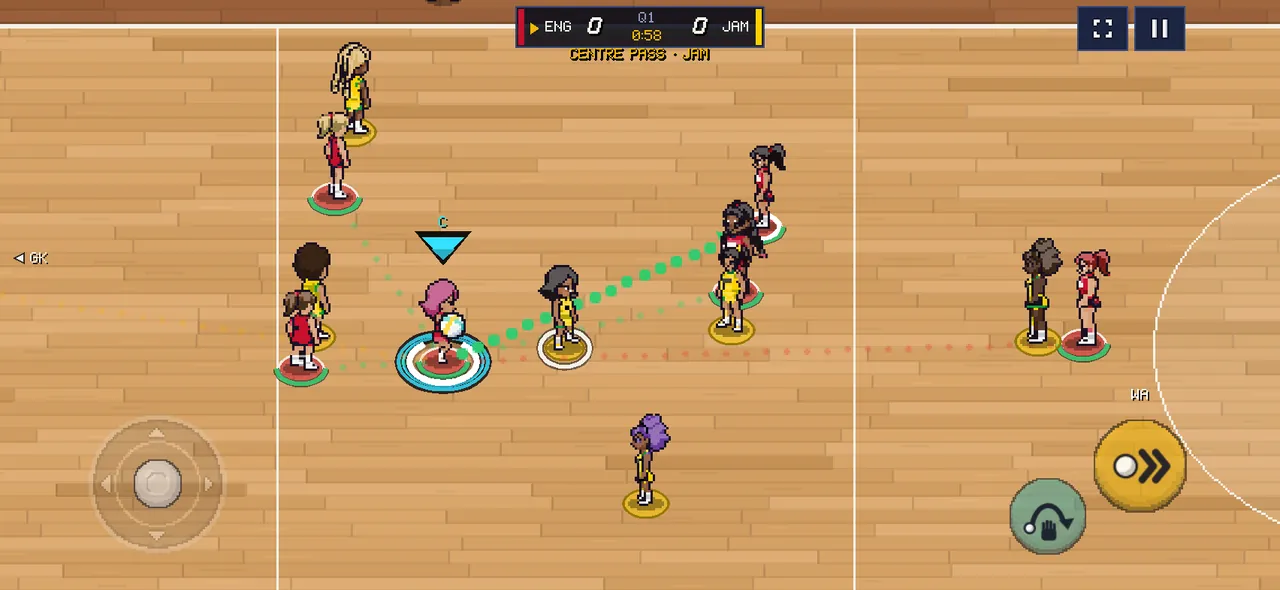
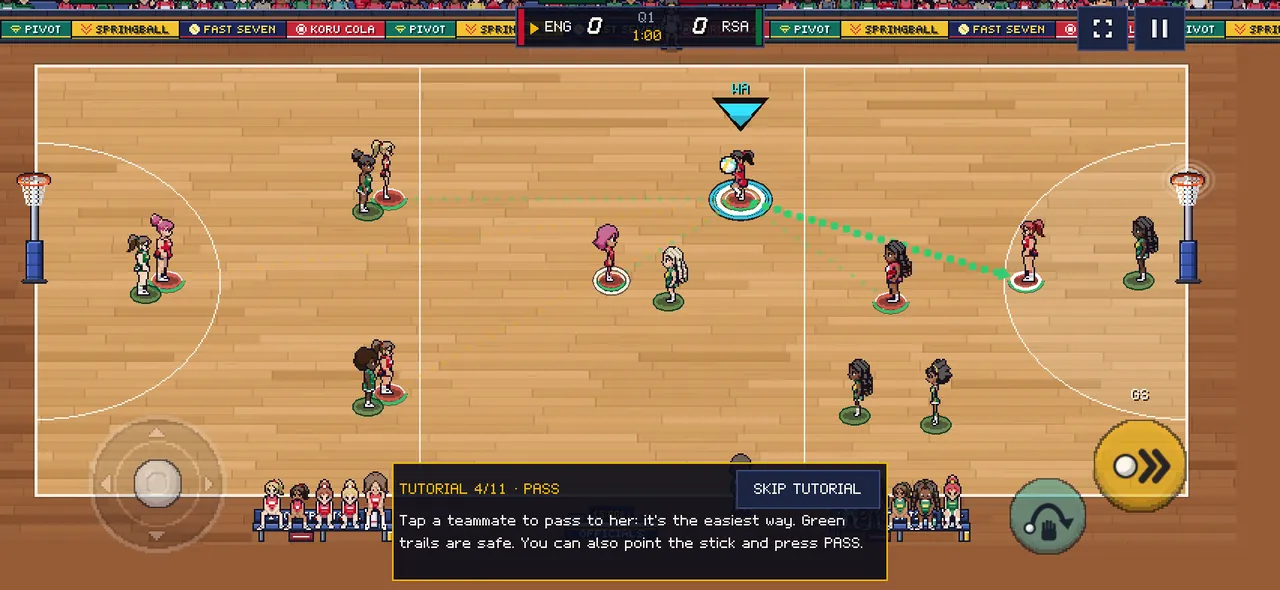
While you hold the ball, a trail of dots runs to every teammate you could pass to. The colour comes from the game's own interception model:
- Green: safe.
- Amber: risky.
- Red: a defender can cut it out. Not always lost: about one red pass in five is.
The pass you're aiming at has a thick trail, a ring at her feet and her position letters on the PASS button. A pass the rules don't allow gets no trail, and tapping that teammate tells you why.
Defending you can do
- Run at the ball. Your defender stops at arm's length from the player with the ball and puts her arms up by herself, so running in isn't a foul.
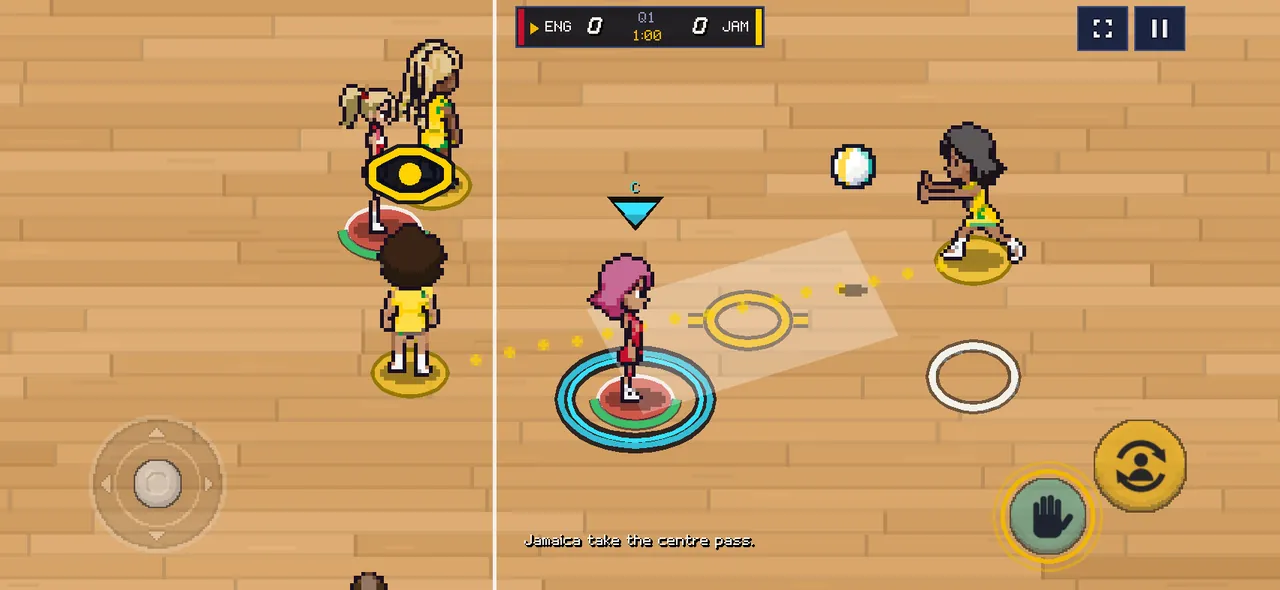
- Watch the look. Before she passes, the computer's player looks at her target: an eye over the receiver and a trail in her team's colours. A pale band shows the part of the pass you can reach, and control moves to your player nearest it.
- JUMP as the ring closes. A ring closes on the spot where your player meets the ball. Gold means she can reach it, grey means move closer. How far she springs depends on the level: furthest on Rookie, not at all on World Class.
- Stand here. When nothing is happening, a faint spot on the floor shows where to stand.
The chain
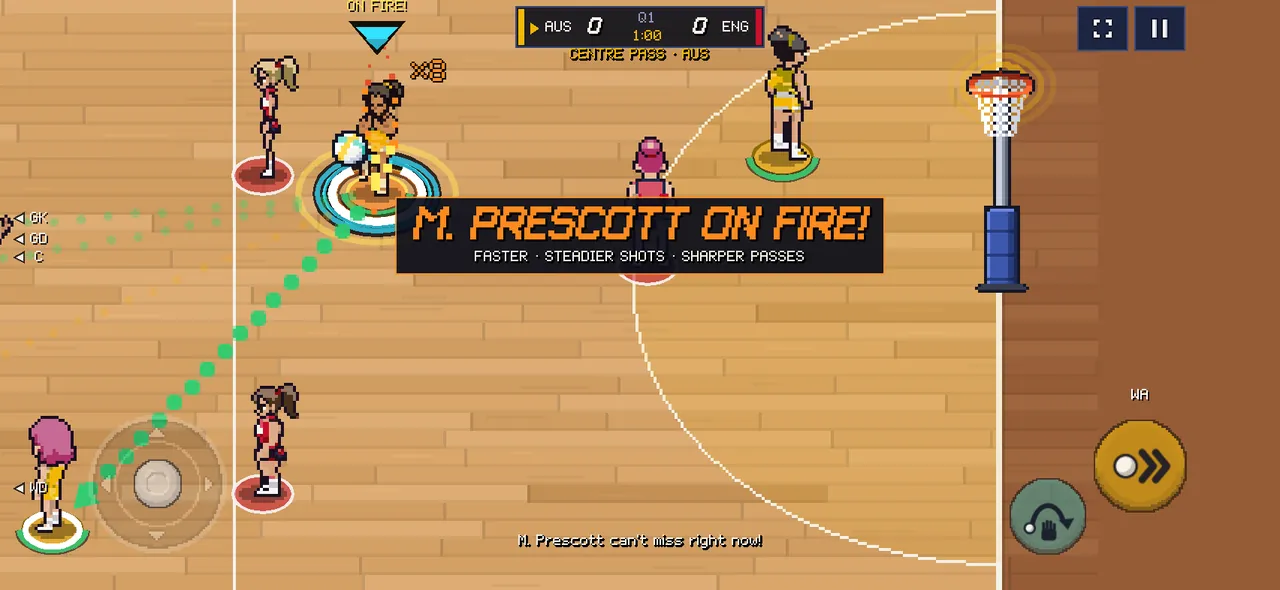
A completed pass that gains new ground, further up the court than any catch so far in that possession, adds a link. The counter beside the ball goes ×2, ×3 and on: white, gold from 4, fire orange from 8. The first five links widen your shot window. Lose the ball and the chain breaks; score and it's banked.
- QUICK HANDS: while your pass is in the air, tap the next teammate (or press PASS for the one the white ring picks). The catcher passes it on at once. It's a gamble, and it earns a bonus link.
- ON THE LEAD: when a teammate sprints into space with a green pass to her, her ring flashes. Pass to her for a bonus link.
- ON FIRE: link eight and your catcher catches fire: faster, steadier shots, sharper passes. A run of goals or intercepts does it too, for both teams.
Goals name the move, like 5-PASS GOAL or FAST BREAK, and the results show your longest chain.
The rules, taught on the spot
The tutorial takes under three minutes in eleven short steps: moving, trying the camera views, tapping a teammate to pass, QUICK HANDS and the JUMP. It ends by letting you choose your match length. After that, a rule tip shows at the whistle the first time a call comes up, with a few seconds to read it.
- Footwork: no running with the ball. Land, pivot, pass.
- Held ball: three seconds to get rid of it. A band at your feet counts down.
- Contact and obstruction: play the ball, not the player, and defend from 0.9 m.
- Centre pass: only the Centre takes it from the circle; everyone else waits for the whistle.
- Shooting: only the Goal Shooter and Goal Attack, from inside the circle. Every miss says why: your timing, the contest, the range.
Seven positions, seven bibs
Each player has her zones. Step out of them and the umpire blows. Switch between them to defend, and the game keeps the others in shape.
- GSGoal Shooter: shoots from the circle. Attacking third only.
- GAGoal Attack: feeds and shoots. Attacking two-thirds.
- WAWing Attack: feeds the circle, never steps into it.
- CCentre: takes the centre pass and runs the game. Everywhere but the circles.
- WDWing Defence: shadows the Wing Attack.
- GDGoal Defence: marks the Goal Attack. Defending two-thirds.
- GKGoal Keeper: guards the post. Defending third only.
However long you've got
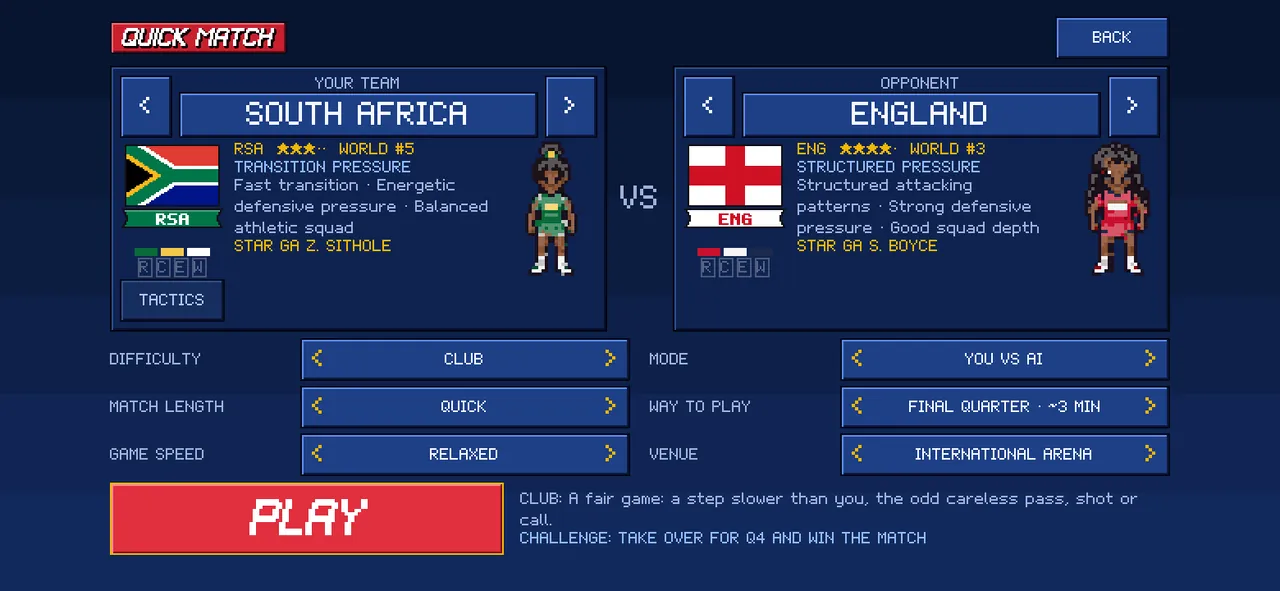
Four ways to play
Pick one for any match: a friendly, a tournament fixture or a career game. These times are for Quick matches (four 1-minute quarters). Standard and Long matches take longer.
Full match
~7 minAll four quarters, every centre pass.
Highlights
~4 minThe game plays the start of each quarter for you; you take the closing stretch of every one.
Final Quarter
~3 minThree quarters are simulated and you take over for a 2-minute last quarter, with a challenge: come from behind, break the tie or hold the lead.
Instant result
SecondsNo time today? Simulate it. The simulation plays the same netball as the matches you play.
Mid-match, the pause menu can also simulate the rest of the game.
Four levels
Your first match is on Rookie. Each level says what it changes when you set up a match:
- Rookie: Holds and looks long before passing, misses shots. Full help with interceptions, catches and shots.
- Club: Holds a while and looks before passing, the odd careless shot. No extra interception help.
- Elite: Passes after a short look, reads your passes, shoots well. No extra interception help.
- World Class: Passes at once with barely a look, reads your passes, rarely misses. No extra interception help.